Introduction
As digital marketing evolves, advertisers still face the same problem. They must pick the platform that gives them the most for their money. The debate over Google Ads vs Facebook Ads has grown more intense in 2026. Meanwhile, both platforms have added features and adapted to changing user behavior. Each brings unique benefits, especially when you use them together. In addition, both offer billions of active users and highly accurate targeting. However, telling which ad platform is better in 2026 depends on your business objectives, audience, and budget.
Understanding Google Ads in 2026
Google Ads 2026 remains one of the most effective tools for attracting customers with clear buying intent. Artificial intelligence, predictive analytics, and automation help advertisers reach buyers at the exact moment they search for a product or service. To illustrate, Google Ads for e-commerce helps retailers draw in qualified buyers who are ready to complete a purchase. The platform’s power comes from combining search, display, YouTube, and Google Shopping for different ad objectives.
Exploring Facebook Ads in 2026
On the other side, Facebook Ads 2026 is still the leader in social engagement and audience targeting. With Meta’s ecosystem (Facebook, Instagram, Messenger, and WhatsApp), advertisers can target detailed audiences. For example, they can use interests, behaviors, or demographics. Facebook ads for lead generation are very potent. In addition, the platform connects easily with lead forms, chatbots, and retargeting strategies. In contrast to search-based ads, Facebook is best at creating demand that is not capturing only.
Key Comparison: Google Ads vs Facebook Ads
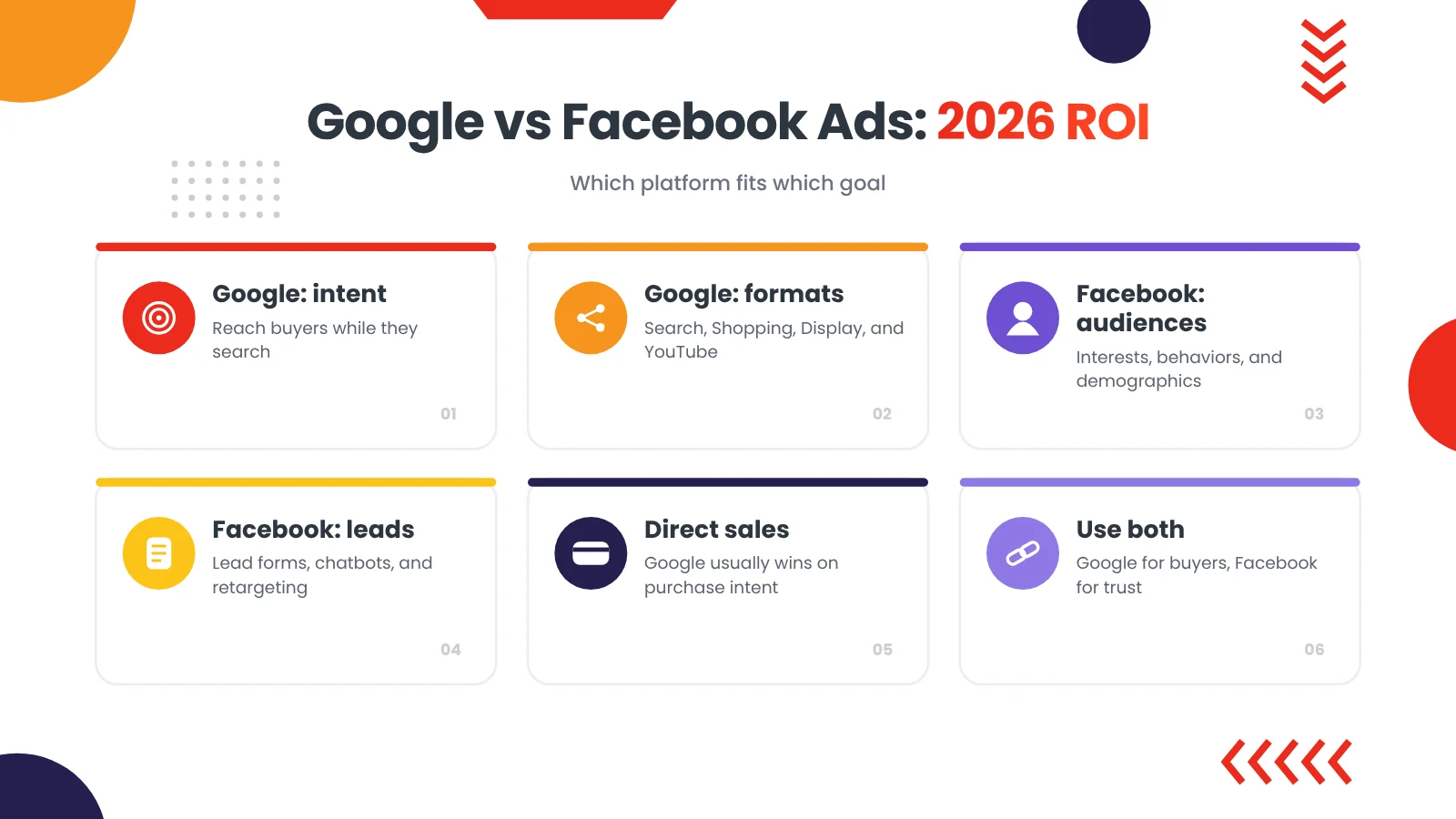
To simplify the Facebook vs Google advertising comparison, here is a detailed overview of how the two platforms stack up in 2026:
| Feature | Google Ads 2026 | Facebook Ads 2026 |
| Audience Targeting | Based on keywords, search intent, demographics, and AI-driven signals | Based on interests, behaviors, lookalike audiences, and social data |
| Best For | Google Ads for ecommerce, direct sales, high-intent buyers | Facebook ads for lead generation, brand awareness, community building |
| Ad Formats | Search, Display, YouTube, Shopping, Discovery | Image, Video, Carousel, Stories, Messenger, Reels |
| Cost & ROI | Often higher CPC but stronger purchase intent | Lower CPC with broader reach but less direct intent |
| Strengths | Intent-driven, measurable, scalable across search & video | Social engagement, visual storytelling, viral reach |
| Weaknesses | Expensive in competitive niches | Less effective for direct conversions in high-ticket items |
| Best ROI Potential | Google Ads vs Facebook Ads ROI favors Google for ecommerce | Facebook for nurturing leads and building brand trust |
ROI: Facebook Ads ROI vs Google Ads
Depending on the industry, the outcome of the comparison Facebook ads ROI vs Google Ads varies. Google benefits companies that sell products directly online the most. After all, purchases are their main goal. For instance, if an e-commerce store promotes itself with Google Ads for e-commerce, it reaches buyers searching for exact products. On the other hand, service-oriented businesses or B2B companies usually earn a better return via Facebook ads for lead generation. There, building contacts and retargeting matter more.
Google Ads vs Facebook Ads: Which Platform is Better in 2026?
Choosing which ad platform is better in 2026 is dependent on the goals/objectives:
- For direct sales and e-commerce growth, Google Ads 2026 is the best solution. That is because it captures the strongest user intent.
- For awareness, engagement, and leads, Facebook Ads 2026 is the better fit. This is because it offers deeper audience insights
- Businesses that want a full-funnel approach can use both platforms. For example, they can use Google to capture active buyers and Facebook to build long-term trust.
Conclusion
In 2026, the Google Ads vs Facebook Ads question is no longer about one platform dominating. Instead, it is about which one fits your business objectives better. For instance, for short-term sales and high-intent traffic, Google Ads 202 is undoubtedly the champion. On the other hand, to widen your audience, nurture relationships, and create pre-qualified prospects, Facebook Ads 2026 may be more valuable.
Most times, the best and effective method is simply using a combination of both. This allows you to tap into each one’s advantages for a greater presence and return on investment. Finally, the dilemma is no longer simply the comparison between the Facebook ads ROI vs Google Ads. Instead, it is about using both platforms together as one complete advertising plan for the intense 2026 digital market.